Inside a CNN: Testing Similar and Dissimilar Images

I used CNN Explainer to follow two images through a small convolutional neural network: an espresso, which matches one of the model's trained classes, and a sunflower, which does not. Comparing them exposed a basic limitation of image classifiers: a model can only choose from the labels and examples represented in its dataset.
The Activity
CNN Explainer visualises a pretrained Tiny VGG network in the browser. It accepts a 64 × 64 RGB image and shows the activation maps produced by convolution, ReLU and max-pooling layers before flattening the learned features and applying softmax across ten output classes.
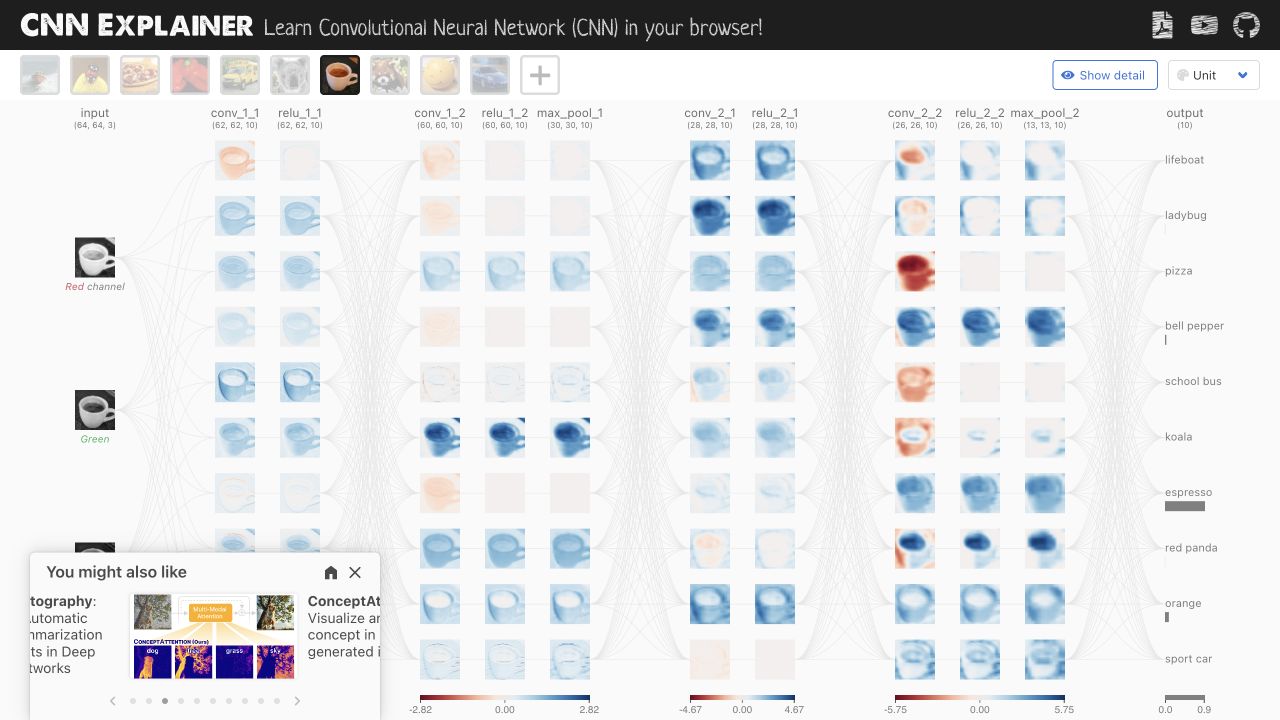
The full network. Each column is a layer and each small square is an activation map.
I first explored the supplied examples to understand the interface. I then used two public-domain photographs from Wikimedia Commons:
- Espresso 01.jpg, photographed by Calvin Ballantine and released into the public domain.
- Sunflower.JPG, photographed by Adam Monkhouse and released into the public domain.
The espresso is a similar image because espresso is one of the model's output classes. The sunflower is deliberately dissimilar: there is no sunflower, flower or general plant class among the ten possible answers.
What Changed Across the Layers?
The early convolutional maps still resembled the input. On the espresso image, different filters emphasised the rim of the cup, the saucer, shadows and changes in brightness. These are local features rather than a complete concept of “coffee”.
The ReLU layer applied max(0, x) element by element. Positive responses remained visible, while negative responses were replaced with zero. In the selected example below, an input activation of -0.2 therefore produced an output of 0. This sparsity helps the network retain useful responses and introduces the non-linearity needed to learn more complex patterns.

An early ReLU activation: negative values are suppressed while positive filter responses are retained.
As the image travelled deeper into the network, the activation maps became smaller and less recognisable. Max-pooling reduced their spatial size by keeping the strongest response in each local region. Later convolutional layers combined simple edges and colour changes into more abstract arrangements. The final pooling layer produced ten 13 × 13 maps, which were flattened into a vector of 1,690 values for classification.
Similar Image: Espresso
The uploaded espresso produced a strong and coherent path through the network. Several early maps clearly highlighted the circular cup and saucer, and later maps responded to more selective combinations of these features.
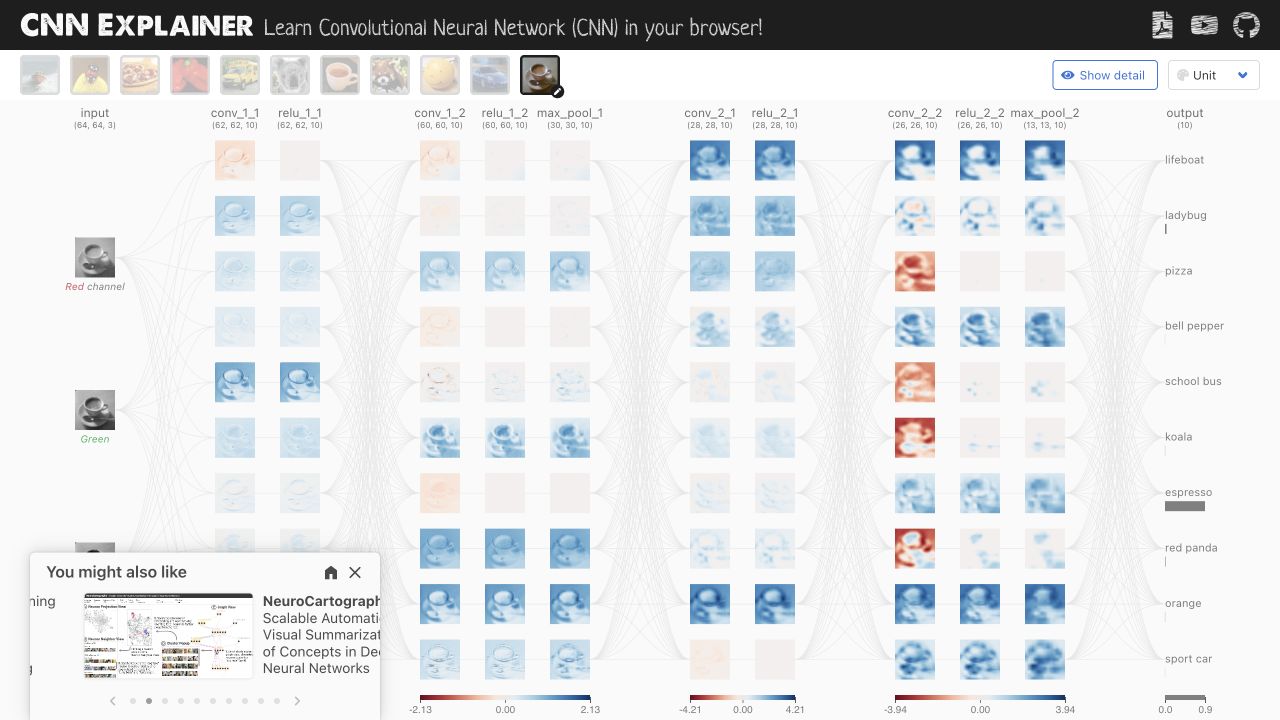
The uploaded espresso moving through convolution, ReLU and pooling layers.
The final softmax output assigned 93.49% to espresso. The next-highest score was only about 3.58% for ladybug. This result makes sense because the object belongs to a trained class and shares useful visual characteristics with the training examples.
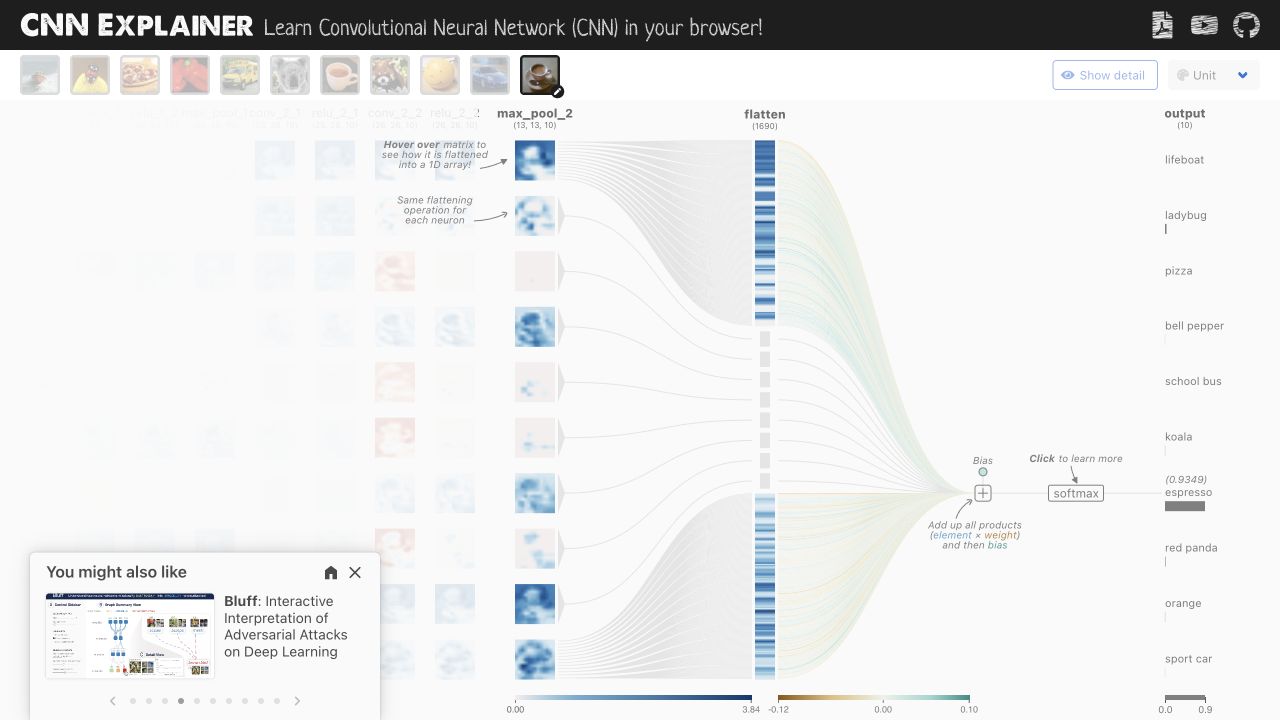
Flattened features feed the softmax output, which scores the uploaded image as espresso at 0.9349.
Dissimilar Image: Sunflower
The sunflower created strong circular and radial activation patterns, especially around the flower head. Those patterns survived into deeper layers even though the network had never been given a sunflower label.
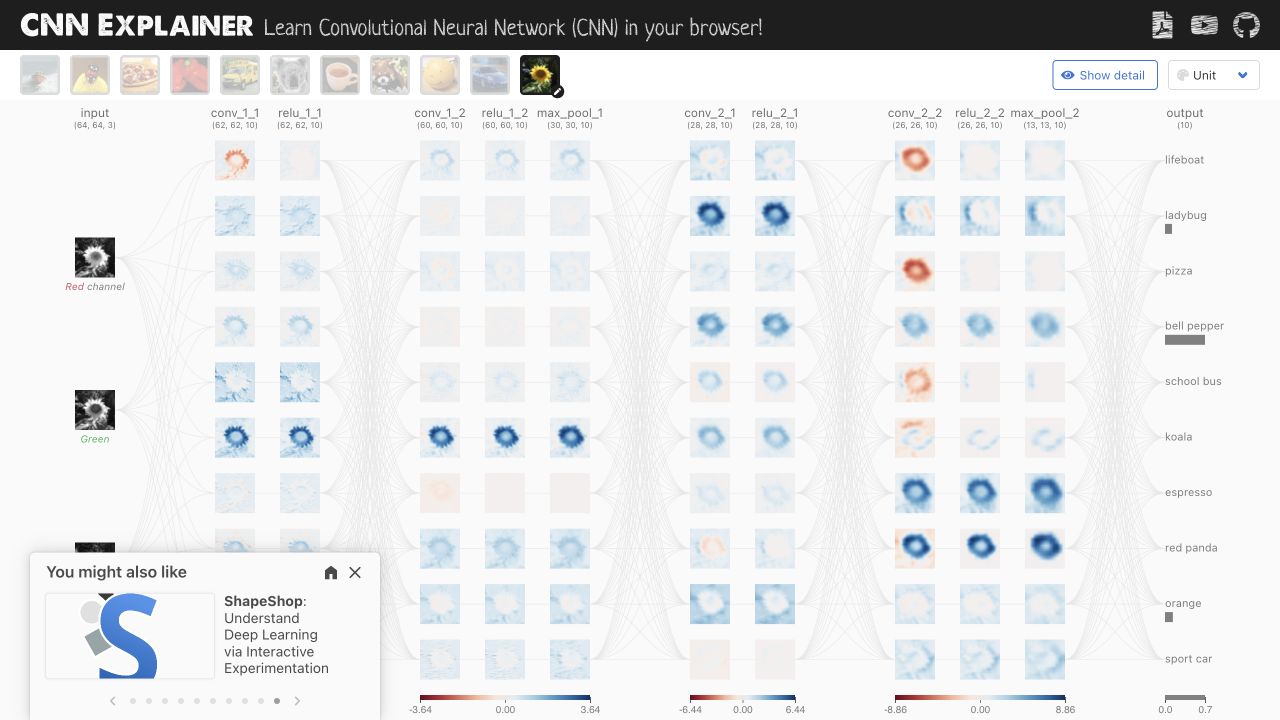
The sunflower also produces meaningful activations, but the correct semantic class is unavailable.
Softmax then had to distribute all probability across the ten known classes. It returned 72.82% for bell pepper, approximately 14.36% for orange, and 12.74% for ladybug. The radial shape, warm colour and central region may resemble features the network learned for those classes, but bell pepper is not a meaningful description of the image.
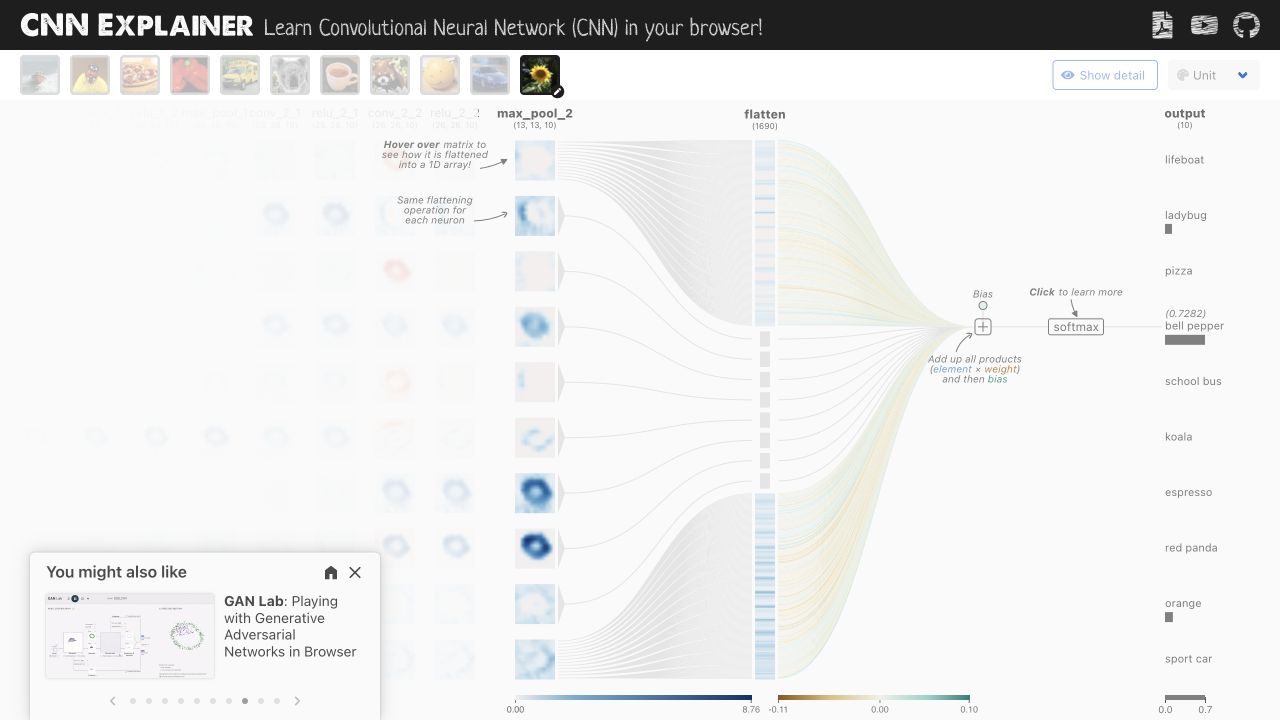
The dissimilar image is confidently forced into the nearest available class: bell pepper at 0.7282.
Dataset Applicability and Challenges
The experiment showed why dataset design is just as critical as model architecture. A compact ten-class dataset makes the network fast enough to inspect interactively and is useful for learning how layers transform an image. It is not representative of open-world image recognition, where an input may contain one object or several at once.
The espresso result shows that CNNs can generalise beyond an exact training photograph when the new image is similar to the training distribution. However, the sunflower exposes a different problem: softmax confidence is conditional on the available labels. It answers “which of these ten classes is most likely?”, not “is this actually one of these ten classes?”. A high score can therefore be confidently wrong when the dataset omits the true class.
Other challenges include limited variation in viewpoint, scale, background and lighting; class imbalance; low-resolution inputs; and hidden bias in how training images were collected. A stronger evaluation would use many images per condition, include out-of-distribution examples, report top-k predictions and calibration, and allow the system to reject an image as unknown when no class is suitable.
Reflection
Looking inside the intermediate layers made the classification more understandable. Early layers detected local visual patterns, ReLU removed negative responses, pooling compressed the representation and later layers assembled increasingly abstract evidence. However, none of those operations can recover a label that is missing from the training task. The model's usefulness is limited by both the quality of its learned features and the scope of its dataset.
References
- Wang, Z.J. et al. (2020) CNN Explainer: Learning Convolutional Neural Networks with Interactive Visualization.
- Polo Club of Data Science (2020) CNN Explainer.
- Wang, J. (2020) CNN Explainer demo video.